

Wake Up Naturally: The Best Sunrise Alarm Clocks for a Better Morning
Waking up shouldn’t feel like a battle. Whether you’re a heavy sleeper, living in a windowless room, or simply tired of jarring alarms, sunrise alarm clocks offer a gentler, more natural way to start your day. These devices simulate the gradual rise of morning light, helping your body ease out of sleep and align with your circadian rhythm—without the shock of a blaring ringtone.
But not all sunrise alarms are created equal. Some double as air purifiers, others integrate with smart home systems, and a few go minimalist with gesture controls and ambient lighting. This guide distills the top-performing models based on real-world feedback, Reddit sentiment clusters, and buyer-focused reviews. From trusted brands like Philips and Hatch to multifunctional newcomers like BLUEAIR and Vivilumens, we break down what matters most: wake-up effectiveness, build quality, customization, and value.
Whether you’re optimizing your sleep hygiene or curating a tech-savvy bedroom setup, this guide will help you choose the sunrise alarm that fits your lifestyle—and actually gets you out of bed.
How We Chose These Sunrise Alarms — And Why You Can Trust This Guide
This guide isn’t built on marketing fluff or affiliate bias. Every product featured here was selected through a rigorous, buyer-focused process that prioritized real-world performance over brand hype. We analyzed hundreds of Reddit threads across productivity, sleep hygiene, and lifestyle communities—extracting sentiment clusters, use-case breakdowns, and firsthand user reviews. These aren’t cherry-picked testimonials; they’re field-tested insights from people who live with these devices daily.
We focused on five key criteria:
- Wake-Up Effectiveness: Does the light actually help users wake up feeling refreshed?
- Build Quality & Longevity: Is the device durable enough for long-term use?
- Customization & Control: Can users tailor the experience to their sleep habits?
- Simplicity vs. Smart Features: Does it serve tech-free users as well as smart home enthusiasts?
- Value for Price: Does the product justify its cost with meaningful features?
This isn’t a list of what’s trending—it’s a tactical selection of what works. Whether you’re a heavy sleeper, a minimalist, or a data-driven optimizer, every product here earned its spot through performance, not promotion.
Overviews
Philips Wake-Up Light (HF3520 Series)


Widely regarded as the most reliable analog sunrise alarm. It simulates a gradual sunrise with customizable brightness and includes nature sounds and FM radio. No app required, making it ideal for tech-free bedrooms. Durable, intuitive, and clinically tested for wake-up effectiveness.
Pros:
- Proven multi-year durability
- Natural light progression without app dependency
- Multiple sound options including FM radio
- Effective in windowless or seasonal environments
Cons:
- Mid-tier price point
- Bulky design compared to newer models
- No smart home integration
Vivilumens Sunrise Alarm Clock
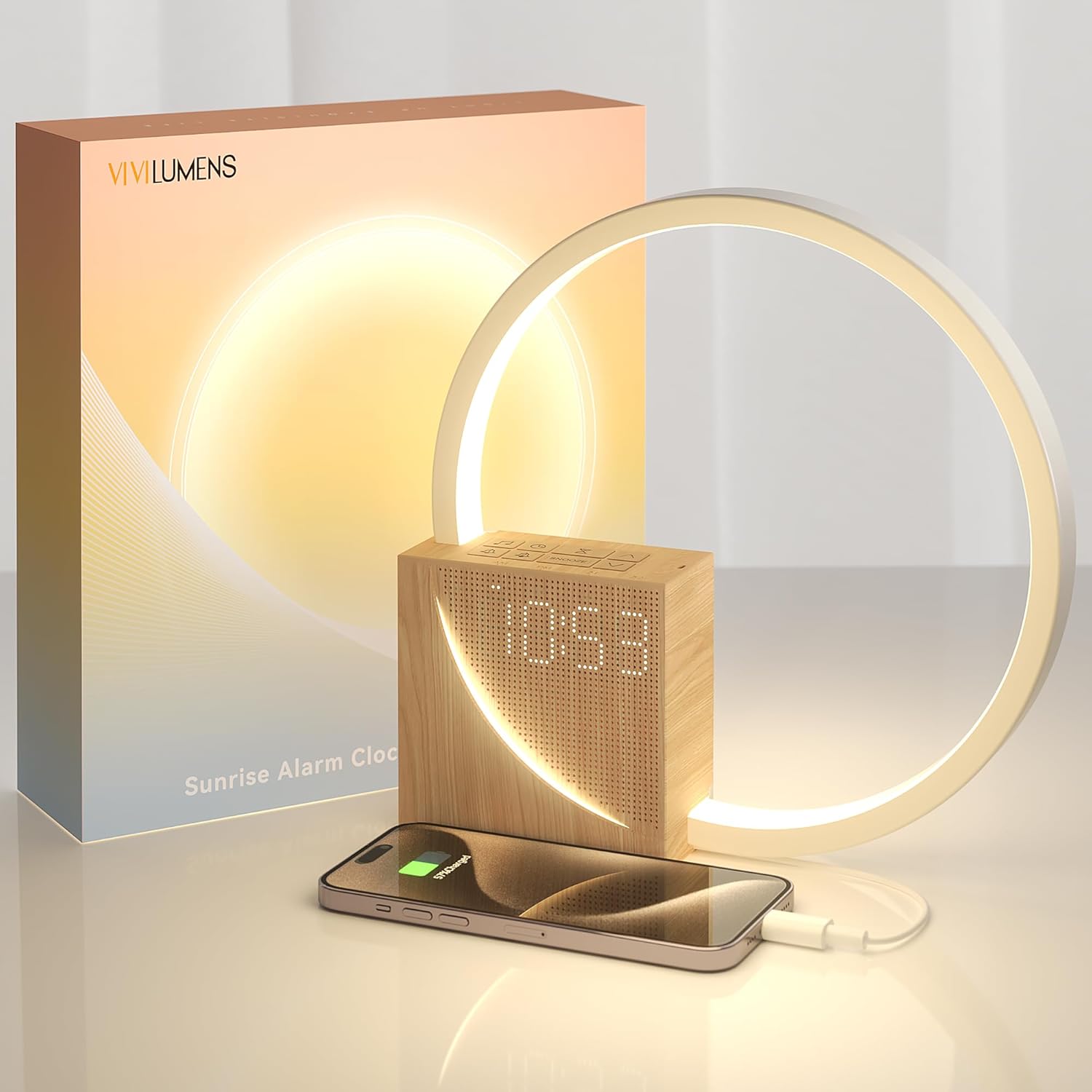
This clock is engineered for users who struggle with abrupt wake-ups. It simulates a gradual sunrise over 10 minutes, offers 10 white noise options, and includes dual alarms with snooze. The 3-level dimmable touch lamp doubles as a nightlight, and the built-in USB port adds bedside utility. It’s a feature-rich, budget-friendly alternative to premium sunrise alarms, ideal for tech-light setups or giftable use cases.
Pros:
- Simulated sunrise with adjustable brightness for gentle wake-up
- 10 soothing sound options including ocean waves, rain, and thunder
- Dual alarm functionality with snooze—great for heavy sleepers
- 30/60/90-minute sleep timers for sound machine
- Touch-sensitive lamp with 3 brightness levels
- USB charging port for added convenience
- No app or Wi-Fi required
Cons:
- Light intensity may be insufficient for large or bright rooms
- Instructions can be complex for first-time setup
- No smart home integration or app control
- Build quality is functional but not premium
Lumie Bodyclock Rise 100

Popular in UK-based threads, this model offers medical-grade light simulation with a simple interface. No app required. Designed for users who prioritize light quality and reliability over smart features.
Pros:
- Medical-grade light spectrum
- No app or Wi-Fi required
- Compact and straightforward design
- Strong reputation for longevity
Cons:
- Limited sound options
- Not widely available outside Europe
- No smart home integration
Casper Glow Light

The Casper Glow Light is a minimalist, gesture-controlled smart lamp designed to simulate sunset and sunrise transitions. It’s portable, rechargeable, and ideal for users who want a gentle, light-only wake-up experience without sound. The intuitive controls—flip to turn on/off, twist to adjust brightness—make it a favorite among design-conscious buyers and those seeking a tech-light sleep aid.
Pros:
- Elegant, modern design that blends into any bedroom
- Gesture-based controls (flip, twist, shake) for intuitive use
- Portable and rechargeable with wireless charging base
- Emits warm, amber-toned light that avoids blue light disruption
- Effective for wind-down routines and gentle wake-ups
- No app required for basic operation
Cons:
- No audio alarm—light only, which may not wake heavy sleepers
- Limited customization compared to app-based sunrise alarms
- No smart home integration (Alexa, Google Home)
BLUEAIR Mini Restful Sunrise Clock Air Purifier

This all-in-one bedside unit combines a HEPASilent™ air purifier, sunrise simulation light, and sound machine into a compact, app-connected device. It’s designed for users who want to improve both air quality and sleep hygiene without cluttering their nightstand. With whisper-quiet operation, USB-C charging, and app-based scheduling, it’s ideal for small bedrooms, nurseries, or tech-forward sleep setups.
Pros:
- HEPASilent™ filtration removes 99.97% of airborne pollutants down to 0.1 microns
- Sunrise simulation with adjustable brightness supports natural wake-up cycles
- 11 calming soundscapes for sleep and wake routines
- App connectivity for scheduling and customization
- USB-C port for bedside device charging
- Quiet operation (as low as 18 dB), ideal for light sleepers
- Compact footprint fits easily on nightstands
Cons:
- Designed for small rooms (optimal up to ~140 sq ft)
- App required for full feature access
- Premium price point compared to single-function devices
- No smart home integration (e.g., Alexa, Google Assistant)
Sources
▮ https://www.reddit.com/r/productivity/comments/bd2zwm/anyone_tried_those_sunrise_alarms/ ▮ https://www.reddit.com/r/BuyItForLife/comments/10tbfno/sunrise_alarm_recommendations/ ▮ https://www.reddit.com/r/Adulting/comments/xs6qhg/recommendations_for_a_sunrise_alarm_clock/ ▮ https://www.reddit.com/r/GetOutOfBed/comments/18dufpf/what_sunrise_alarm_is_the_best_in_the_market/ ▮ https://www.reddit.com/r/productivity/comments/1845myy/sunrise_alarm_clock_or_smart_bulb_in_2023/ ▮ https://www.reddit.com/r/productivity/comments/96ggna/how_a_sunrise_simulating_alarm_clock_changed_my/ ▮ https://www.reddit.com/r/malelivingspace/comments/11qer0y/anyone_have_a_good_sunrise_alarm_clock_they/—


